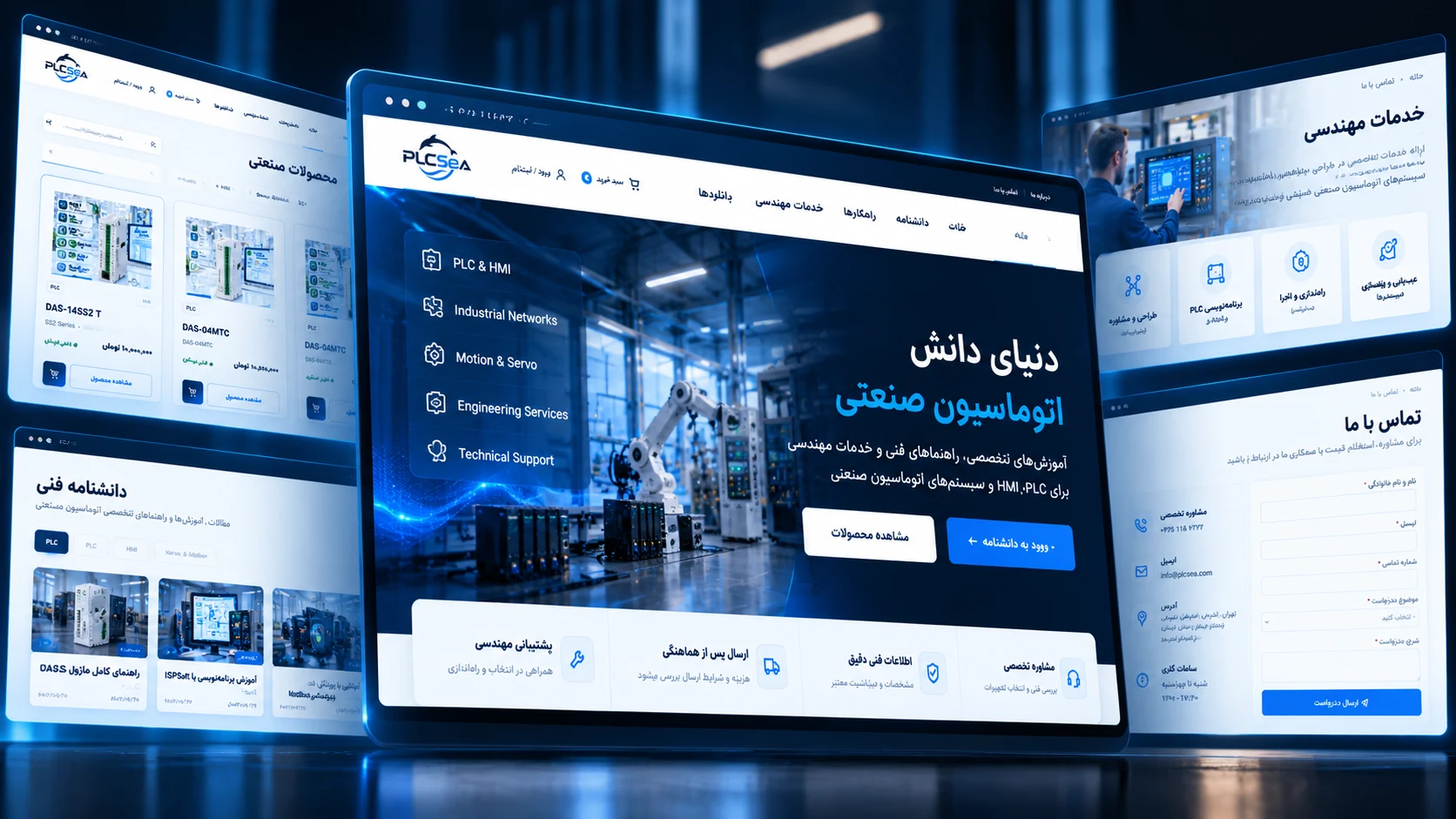

Designing and developing a content-driven and commercial platform for PLC education, technical knowledge, and DAS product sales
When PLCSEA came to us, the client had already spent some time trying to build the website independently. Part of the journey had been completed, but the result was still far from what they had in mind.
The goal was never to build a simple corporate website or a standard online store.
PLCSEA was intended to grow into a specialized reference platform for PLCs and industrial automation — a place where users could learn, explore technical subjects, understand industrial technologies, and also discover and order products from the DAS brand.
The challenge was that there were many ideas, but there was not yet a clear structure for turning them into a coherent digital product.
Starting Over Instead of Extending the Wrong Foundation
Before working with NaarCode, the client had already started building the website and had made some progress.
As the idea became larger, however, it became clear that continuing with the existing structure would not produce the kind of platform they were aiming for.
Building a technical reference platform required more than adding a few pages and a shop.
We first needed to answer questions such as:
- What types of content would the platform contain?
- How should products be organized?
- How should educational articles and technical resources be structured?
- How should users move between learning content, products, services, and solutions?
- And most importantly, how could the platform remain scalable as more content was added?
For that reason, we decided to redesign and rebuild the project from the ground up rather than continue patching the earlier version.
The Goal: Knowledge and Commerce in One Ecosystem
The main goal behind PLCSEA was clear from the beginning:
to create an environment where technical knowledge and products could exist side by side.
On one side, the platform needed to gradually become a useful source for topics such as PLC programming, industrial communication, control systems, automation equipment, and practical engineering knowledge.
On the other side, products from DAS needed to be presented and made available within the same experience.
The purchasing model was also different from a typical e-commerce store.
Users can add products to their cart, but the final process is based on price inquiry and order submission, which is much better aligned with the way industrial equipment is often purchased.
From the start, the project therefore had to support three parallel goals:
Technical education and knowledge Product discovery and ordering A long-term SEO foundation for content growth
The Main Challenge: Plenty of Knowledge, but No Information Architecture

One of the most important parts of the project happened before the visual interface was designed.
The client had a clear understanding of the topics they wanted PLCSEA to cover, but there was no defined system for organizing all of that information inside the website.
This was where NaarCode’s role became more than simply “designing a website.”
We proposed the structure of the content and the main page architecture, turning a large number of technical ideas into a system that could be understood and expanded.
The platform was organized around areas such as:
- Products
- Services
- Solutions
- Projects
- Technical articles and educational content
- Categories and related tags
The goal was not only to make navigation easier for users, but also to ensure that the website could grow without becoming disorganized.
This structure also allowed knowledge, products, and industrial use cases to be connected instead of existing as isolated pieces of content.
Design: Technical Without Becoming Complicated

The visual direction of the project was fully entrusted to NaarCode.
One of the challenges was that industrial automation is naturally a technical and complex field. If that complexity had been directly translated into the interface, the website could easily have become crowded and difficult to use.
Our goal was to communicate technical credibility while keeping the experience simple and organized.
We focused on several principles:
Clear information hierarchy, so users can quickly understand where they are and what is available on each page.
Controlled and structured layouts, so a growing volume of content does not create visual clutter.
Responsive design, ensuring that the experience remains consistent across desktop and mobile devices.
And finally, a visual system capable of supporting both the educational and commercial sides of PLCSEA.
SEO as Part of the Architecture, Not an Afterthought

One of the client’s core requirements was that the website should be prepared for SEO from the beginning.
The reason was simple: a large part of the platform’s future content would be created and expanded by the PLCSEA team itself.
SEO therefore could not be treated as something to add later through a few plugins or isolated optimizations.
The website architecture was designed with long-term content growth in mind.
During development, we worked on areas such as:
- Page structure
- URL architecture
- Metadata
- Canonical URLs
- XML sitemaps
- Categories and tags
- Optimized images and alt text
- Internal relationships between related articles
- Redirects
- Product page structure
- Indexability of different content sections
We also prepared several initial technical articles to help establish the structure of the knowledge base, covering topics such as Modbus, WPLSoft, ISPSoft, PID control, temperature modules, and load cell modules.
The objective was not to produce all of PLCSEA’s future content ourselves.
The objective was to build a strong framework that the PLCSEA team could continue developing over time.
From Staging to Production
The project was initially developed in a staging environment so that design, development, and content structure could be tested without affecting the main domain.
Once the main stages were complete, the website was migrated to plcsea.com.
The launch process involved more than moving files.
We reviewed and handled areas including:
- Old and new URLs
- Redirects
- Robots directives
- XML sitemaps
- Canonical URLs
- Cache configuration
- Database references
- Google Search Console
The goal was to make sure the site was not only visually ready for launch, but also technically healthy for crawling and indexing.
The Result: A Platform Built to Grow
At the time of writing this case study, PLCSEA has been live for approximately one month.
That means it is still too early to make meaningful claims about SEO growth, traffic performance, or commercial results.
A significant portion of the planned technical content is also still being prepared by the client.
We prefer to be transparent about that rather than present numbers that do not yet exist.
What does exist today is a foundation designed for long-term growth.
The PLCSEA team can now gradually:
- publish technical educational content,
- add more products,
- expand knowledge categories,
- and move the platform closer to the specialized industrial automation reference they originally envisioned.
For us, the first success of the project was this:
turning a large collection of ideas into an organized system that can grow over time.
What We Learned From This Project
In content-heavy platforms, page design is not the first problem to solve.
Before anything else, you need to understand how information will grow, how different pieces of content connect, and how users will navigate between them.
If that structure is weak, even a visually strong website will become difficult to manage as content increases.
PLCSEA reinforced an important principle for us:
information architecture, design, development, and SEO should be shaped together from the beginning.
Project Snapshot
Client: PLCSEA Industry: Industrial Automation Scope: Strategy, Information Architecture, UI/UX, Custom Web Development, Commerce, SEO Foundation Platform: Web Website: plcsea.com
NaarCode — Ideas • Code • Impact